A 1950s family Christmas, in three photographs
A family album from the Mosbacher home, now in a public library collection, shows the part of a gift exchange that is hard to photograph: the waiting.
Upload a photo + a few interests for each person → we draw names and hand every Santa gift picks they're more likely to love.
Start with photos →These photographs come from the Columbus Metropolitan Library's collection, via the Digital Public Library of America. They show the Mosbacher family at home at Christmas. The archive dates two frames to December 1957 and one to 1959. Nobody in them is famous. That is why they are useful.
The gathering
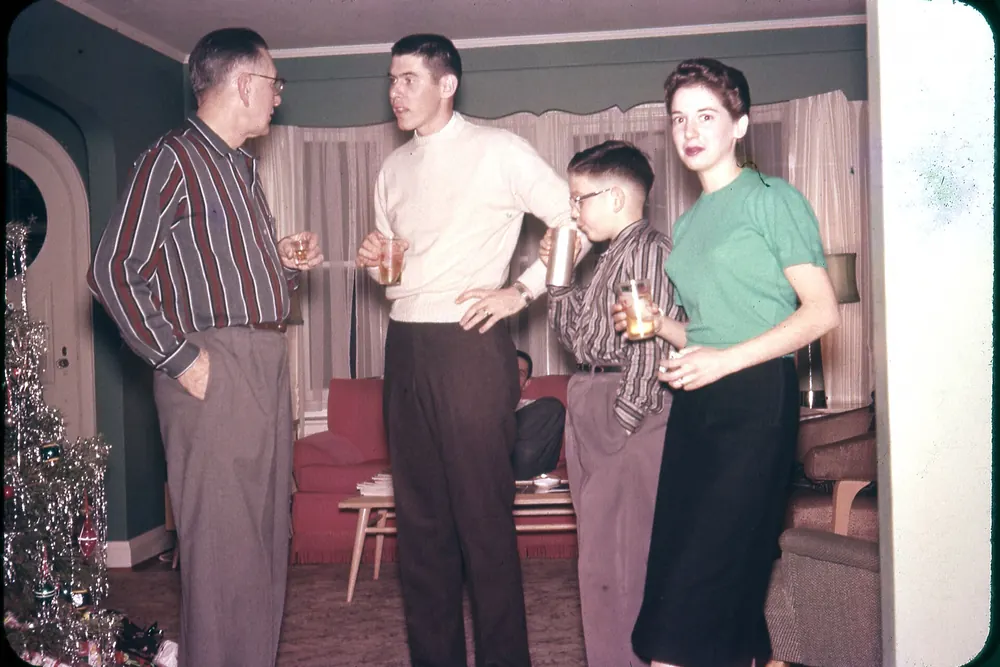
The first photograph is not about presents. Four people stand in a living room, talking. There is a tree at the left edge, a lamp, a couch, a box of tissues. The adults are holding drinks and looking at each other, not at the camera. The archive caption says simply: "Family members gather to talk."
That is the part of a Christmas exchange that organizers often skip. Before the gifts, there is a room. The room has to be warm enough, big enough and relaxed enough for people to stand around in it. The best exchange in the world will not fix a room where nobody wants to stay.
The opening
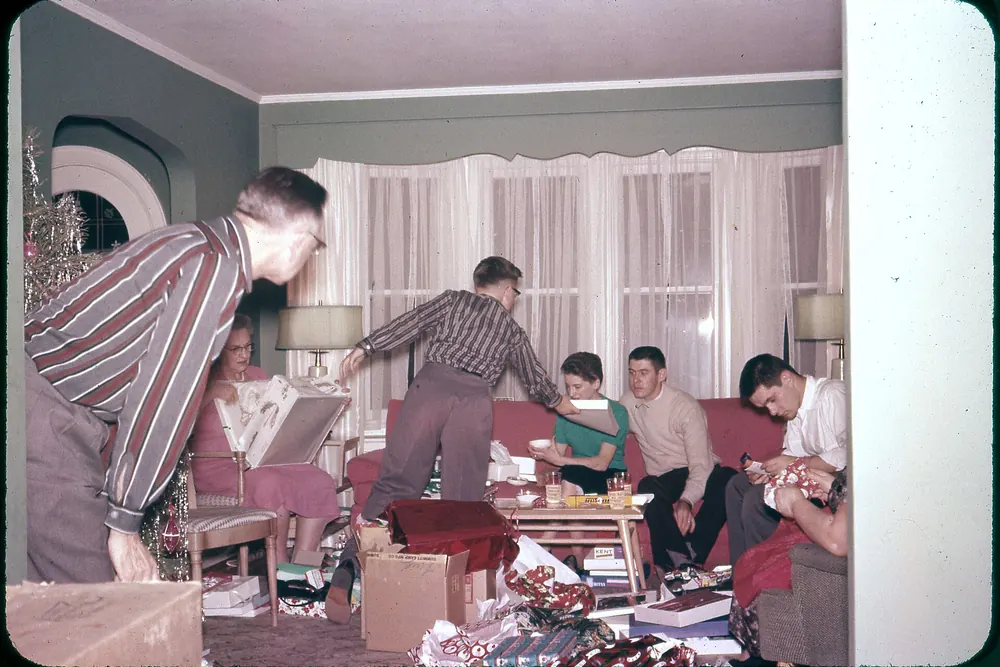
The second photograph is the event itself. The children are on the floor, the adults are leaning in, and the wrapping paper is already spreading. The tree is behind them. Someone is handing something across the room. The flash makes the room look brighter than it probably was.
What strikes me is the choreography. Nobody is performing for the camera; everyone is watching someone else open something. A gift exchange is a small piece of theatre, but the audience is the point. The person opening the gift is not the only one receiving something.
Upload a photo + a few interests for each person → we draw names and hand every Santa gift picks they're more likely to love.
Start with photos →The pause
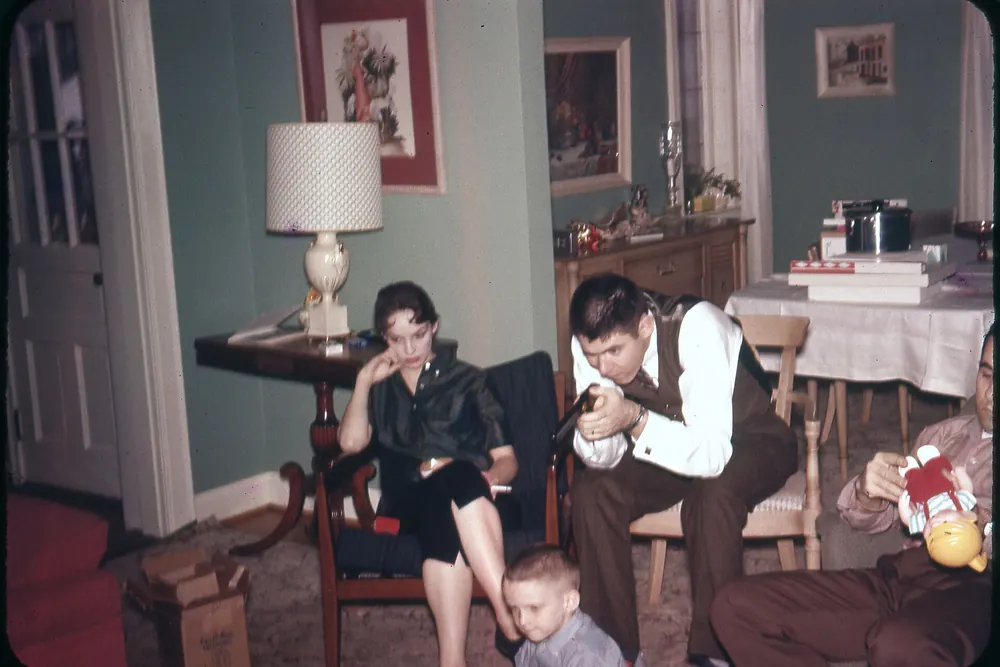
The third photograph is quieter, and the archive dates it to 1959. Two adults sit with a child; the gifts are around them, not yet the centre of attention. You can see the room settling: the lamp, the picture on the wall, the box on the floor.
This is the pause before the next gift, or after the last one. It is the part that a wishlist cannot capture. The exchange has happened; the room is still there; people are still together. That is the actual product.
What changed, and what didn't
The cameras changed. The gifts changed: fewer handmade things, more packaging, higher prices, online wishlists. The rooms changed; the people changed. But the sequence in these photographs is still recognisable. Someone arrives. Someone hands something over. Someone watches. The paper comes off. The room stays.
If you are running a Secret Santa, the photographs are a useful corrective to the spreadsheet. You are not just matching names. You are making a room where a small exchange can happen without anyone feeling exposed. That means a clear budget, a private link, a clear wishlist and a time limit. It also means leaving space for the pause.
Keep the ritual small and the room comfortable. A $10 or $25 limit, a private draw and a printed card are enough. If you are virtual, the same rule applies: make a room, even if it is a video call, and leave time for the pause.
Sources
Keep planning
Questions
Is this a real family?
Yes. The archive labels them the Mosbacher family. We describe what the photographs and captions show; we do not invent their conversations.
Upload a photo + a few interests for each person → we draw names and hand every Santa gift picks they're more likely to love.
Start with photos →Updated October 28, 2026