The Christmas truce of 1914: the original Secret Santa
Before wishlists and group chats, soldiers on the Western Front did something no command had planned: they climbed out of their trenches and exchanged small gifts with the people they had been shooting at.
Upload a photo + a few interests for each person → we draw names and hand every Santa gift picks they're more likely to love.
Start with photos →On Christmas Eve 1914, along parts of the Western Front, the war briefly became a place where people talked. German soldiers placed candles on small trees and sang carols. British soldiers sang back. Men shouted greetings across no man's land. In some sectors, a few climbed out.
What happened — and what didn't
The truce was not one event. It was a patchwork of local decisions, mostly made by junior officers and the men themselves. In some places, soldiers met in the open, shook hands, exchanged cigarettes, cigars, food, buttons and souvenirs. In others, they used the pause to recover wounded men or bury the dead. In many sectors, nothing happened at all; the guns kept going.
There were footballs. Letters from the time describe kickabouts in no man's land, and historians have found evidence of a few organised attempts. The story grew into something bigger than the evidence: a symbolic match, a Christmas miracle. The truth is more human and more interesting. Men who had been ordered to kill each other found a few hours where they could see each other as people.
The photograph is not the whole war
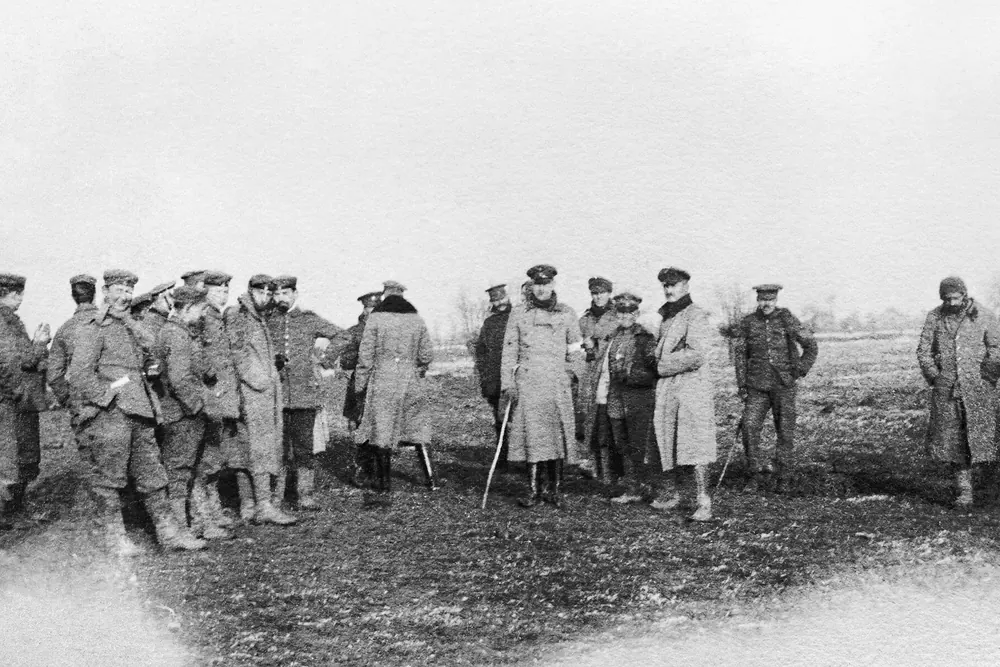
The image at the top comes from the Imperial War Museums collection. Its caption identifies British troops of the Northumberland Hussars, 7th Division, meeting German soldiers in the Bridoux–Rouge Banc sector. It is a real photograph of a real meeting, but it is not a photograph of every sector, every unit or every truce. That is the point: the truce was local, improvised and fragile.
The gift was recognition
Most of the gifts were ordinary: a cigarette, a tin of food, a button, a cap badge. Those objects were not worth much. What mattered was that someone crossed the line to hand them over. The recipient was not a category anymore — not "the enemy" in the abstract, but a cold, tired person with a name and an accent and a family.
That is the part a modern gift exchange can still use. A Secret Santa is not valuable because of the price of the gift. It is valuable because it gives one person a reason to pay attention to another. The present is a pretext for the noticing.
Upload a photo + a few interests for each person → we draw names and hand every Santa gift picks they're more likely to love.
Start with photos →Why it didn't last
Commanders on both sides disapproved. Orders were issued against fraternisation; some soldiers were punished. The war got worse. By 1915, the same informal truces were rarer; by 1916, the bitterness had deepened. The Christmas truce did not stop the war, and it was not repeated at the same scale. It was a window, not a settlement.
What a modern exchange can borrow
- Make it opt-in. The truce worked because men chose to step out. A workplace exchange that people are ordered to enjoy is not a gift; it is a meeting with wrapping paper.
- Keep the gift small. The cigarette and the button were enough. A $10 or $25 limit is not a compromise; it is the point.
- Protect the moment. Don't make people perform gratitude, and don't turn the reveal into a competition. The best exchanges leave room for a quiet "thank you".
If you want the room to feel different, design for the moment of recognition, not the value of the gift. Set a clear budget, keep the draw private, and give people a clear way to say what they like. The rules page has the rest.
Sources
- Imperial War Museums: The Christmas truce
- BBC: Items from the WWI Christmas truce
- Wikipedia: Christmas truce
Keep planning
Questions
Did the Christmas truce really happen?
Yes. There were unofficial, local ceasefires along parts of the Western Front on and around Christmas 1914. They were not universal, and fighting continued in many sectors.
Was there a football match?
Soldiers described kickabouts, and historians have evidence of a few organised attempts. The popular image of one big match is not accurate for every sector.
Why does it matter for a Secret Santa?
It is an extreme example of the same idea: a small, voluntary exchange can make another person visible. The gift matters less than the recognition.
Upload a photo + a few interests for each person → we draw names and hand every Santa gift picks they're more likely to love.
Start with photos →Updated October 28, 2026